
7 min read
What is an ETF?
ETFs now hold over $24 trillion worldwide. Learn what an ETF is, how creation and redemption keep its price close to fair value, and how ETFs compare with mutual funds on cost, trading and taxes.

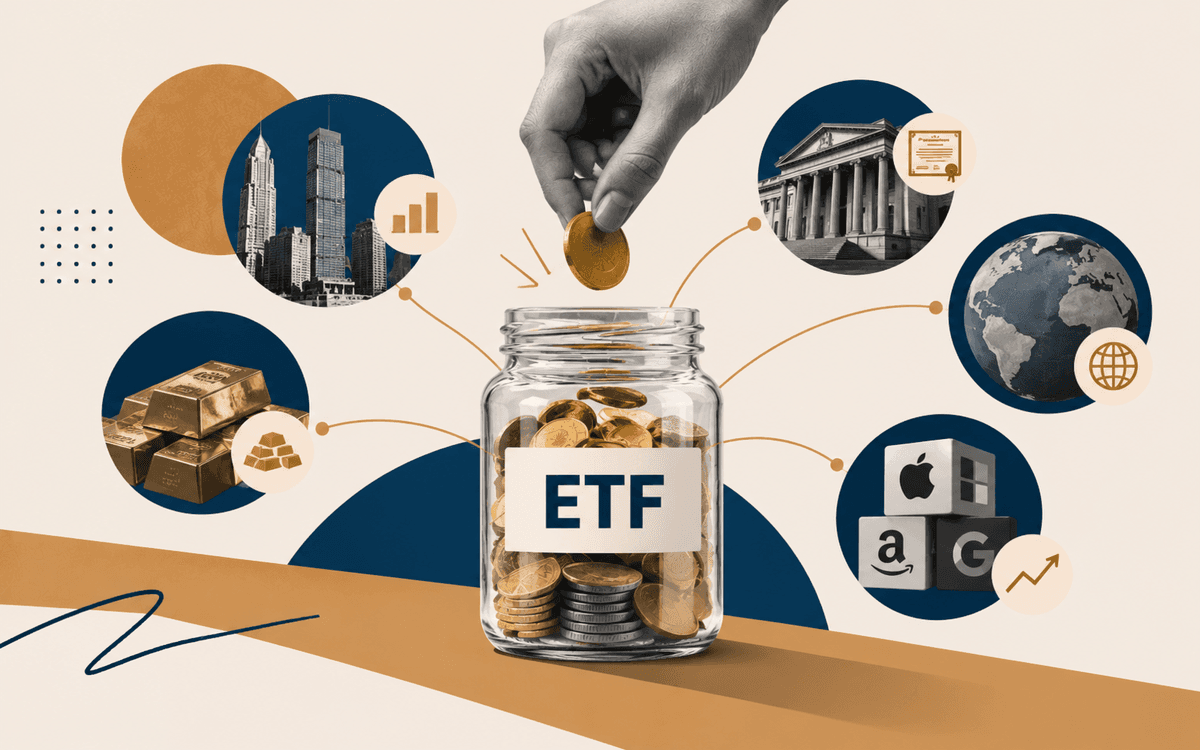
For less than the price of a decent dinner, you can own a slice of all 500 companies in the S&P 500. One click. The tool behind it is the exchange-traded fund, or ETF.
ETFs have quietly become one of the most popular ways to invest. As of the end of August 2026, investors worldwide held over $24 trillion across roughly 17,700 funds. That figure grew by more than 20% in just the first eight months of the year.

Yet plenty of people who own ETFs can’t tell you how they work. So let’s fix that. In this post, I’ll cover:
- What an ETF is
- The creation and redemption mechanism that keeps its price in line with what it holds
- How ETFs compare with their older cousin, the mutual fund
By the end, you’ll know what you’re buying and why it behaves the way it does.
What is an ETF?
An exchange-traded fund holds a basket of assets, such as stocks, bonds or commodities, and its shares trade on a stock exchange like any company’s stock. Buy one share of an S&P 500 ETF and you own a small piece of every company in the index.
The “exchange-traded” part is what sets ETFs apart. You can buy or sell whenever the market is open, at the price other buyers and sellers agree on, through any ordinary brokerage account.
Key terms to know
- Net asset value (NAV): The total value of the fund’s holdings minus its liabilities, divided by the number of shares. This is what one share is worth on paper.
- Market price: What a share actually trades for on the exchange. It usually sits very close to NAV.(Explained in next section)
- Expense ratio: The annual fee, expressed as a percentage of your investment. At 0.05%, a $10,000 holding costs $5 a year.
- Bid-ask spread: The gap between the highest price a buyer will pay and the lowest price a seller will accept. Popular ETFs have very tight spreads. Niche ones can be wider.
- Ticker: The short code an ETF trades under, like a stock’s symbol.

How ETFs are created and redeemed
An ETF's share count isn't fixed. New shares are created when demand rises and removed when it falls, through a behind-the-scenes process between the fund and a handful of large trading firms. This process explains why an ETF's market price stays close to its NAV and why ETFs are so tax-efficient.
The players
- The ETF issuer: the firm that runs the fund, such as iShares, Vanguard or State Street.
- Authorized Participants (APs): large broker-dealers with a contract that lets them create and redeem shares directly with the issuer. Ordinary investors can't do this.
- Investors: everyone else, who buy and sell ETF shares with each other on the stock exchange. This is called the secondary market.
Most of the time, when you buy an ETF share, you are buying it from another investor, not from the fund. The fund itself only deals with APs.
The AP sits between two markets: it swaps securities with the issuer on one side and trades shares with investors on the other.

Creation: making new shares
- The issuer publishes a daily list of the securities, and amounts, that make up one "creation unit."
- An AP gathers that basket of securities, usually by buying them in the market.
- The AP delivers the basket to the issuer.
- In exchange, the issuer gives the AP a block of brand-new ETF shares, typically tens of thousands of shares at once.
- The AP can sell those shares to investors on the exchange.
No cash changes hands between the fund and the AP in a pure in-kind creation. It is a swap: stocks in, ETF shares out.
Redemption: removing shares
Redemption runs the same process in reverse. An AP returns a creation unit's worth of ETF shares to the issuer and receives the underlying basket of securities back. Those ETF shares then cease to exist.

Why it matters: arbitrage keeps prices honest
APs aren't doing this as a favor. They do it because it can be profitable whenever the ETF's price drifts away from the value of what it holds.
- If the ETF trades above NAV (a premium), an AP can buy the cheaper underlying stocks, swap them for ETF shares, and sell those shares at the higher price. The new supply pushes the ETF's price back down.
- If the ETF trades below NAV (a discount), an AP can buy the cheap ETF shares, redeem them for the more valuable underlying stocks, and sell the stocks. Removing shares pushes the ETF's price back up.
Because many APs compete for these small profits, gaps between price and NAV are usually tiny for large, liquid ETFs. You get a fair price without the fund ever having to trade on your behalf.
The tax payoff
The in-kind swap has a second benefit. When an AP redeems shares, the fund hands over securities instead of selling them for cash. A sale would trigger a capital gain; a handover generally doesn't.
Fund managers can also choose which shares to hand over, sending out the ones bought at the lowest prices. That steadily removes built-up gains from the fund. This is the main reason most stock ETFs rarely pay out capital gains to their investors, while many mutual funds do.
When the mechanism strains
The system works best when the underlying assets are easy to trade. When they aren't, the gap between price and NAV can widen.
The clearest example came in March 2020. As the pandemic hit, corporate bond markets nearly froze, and several large bond ETFs traded at noticeable discounts to their stated NAV. Many analysts argued the ETF prices were actually more accurate, since the bonds themselves were barely trading and their quoted values were stale. Either way, it is a reminder that an ETF can only be as liquid as what it holds when markets are under stress.
ETFs vs. mutual funds
ETFs and mutual funds do the same basic job: they pool investors' money into a diversified portfolio. Many index strategies are even sold in both forms. The real differences are in how you buy them, what you pay and how they are taxed.

Why the tax gap exists
When mutual fund investors cash out, the fund usually has to sell holdings to raise the money. If those holdings have gone up in value, the sale creates a capital gain. The fund must pass that gain on to everyone still in the fund, who owe tax on it even if they never sold a share.
ETFs largely sidestep this through the in-kind redemptions described in the previous section. The fund hands over securities instead of selling them, so far fewer gains build up and get distributed.
This advantage only matters in a regular brokerage account. Inside a retirement account like an IRA or 401(k), gains aren’t taxed as they happen, so a mutual fund’s payouts don’t cost you anything that year, and the ETF’s edge disappears.
Things to watch before you buy
ETFs are simple to buy, but they aren't all alike. A few minutes of checking can save you money and surprises.
- Expense ratio: This is the fund’s yearly fee, taken automatically as a small percentage of your investment. You never see a bill, but it lowers your returns every year, and the gap compounds. Over 30 years, $10,000 growing at 7% a year ends up around $75,000 with a 0.05% fee but only about $66,000 with a 0.50% fee. For reference, index stock ETFs averaged 0.14% in 2025, and many broad-market funds charge less. If two funds track the same index, the cheaper one is usually the better pick.
- Bid-ask spread and trading volume: Large, popular ETFs often trade with a spread of a penny or two. Smaller or niche funds can be much wider, which is a hidden cost each time you buy or sell. Using limit orders, and avoiding the first and last few minutes of the trading day, helps.
- Premium or discount to NAV: Most fund websites show how far the market price has strayed from NAV. For large stock ETFs it is usually tiny; for funds holding harder-to-trade assets, it can be meaningful.
- Tracking difference: Compare the fund's return with the index it follows. A fund that consistently lags by more than its fee may be doing a poor job of tracking.
- What it actually holds: Read past the name. Two "tech" or "dividend" ETFs can hold very different portfolios, and some popular indexes are heavily weighted toward a handful of large companies.
- Fund size and age: Very small or new funds are more likely to close. When an ETF shuts down, it sells its holdings and returns cash, which can create a tax bill at a time you didn't choose.
- Complex products: Leveraged and inverse ETFs reset daily and can lose value even when you get the market's direction right over time. Commodity ETFs that use futures can lag the price of the commodity itself, and some issue more complicated tax forms.
- Your own behavior: Because ETFs trade all day, it is tempting to trade them often. For most long-term investors, the best move after buying a broad, low-cost ETF is to leave it alone.
Conclusion
An ETF is a basket of investments that trades like a single stock. Behind the scenes, Authorized Participants create and redeem shares by swapping baskets of securities with the fund. That quiet mechanism keeps prices close to fair value and makes ETFs unusually tax-efficient.
Compared with mutual funds, ETFs offer more trading flexibility, typically lower costs and fewer surprise tax bills. Mutual funds still shine for automatic investing and inside many retirement plans.
ETFs aren't magic. Their structure is simply well suited to how most people invest today. Pick a low-cost fund, understand what it holds, and let time do the heavy lifting.
This article is for informational and educational purposes only and does not constitute financial, investment, legal, or tax advice. Nothing in this piece should be construed as a recommendation to buy, sell, or hold any security or other asset. Markets are volatile, and past performance is not indicative of future results. Do your own research and consult a qualified, licensed advisor before making any investment decisions. The author may hold positions in the assets discussed.